February 14, 2026
The IT Professional Who Lost Money for 90 Days—Then Built a $7,8K/Month Publishing Business
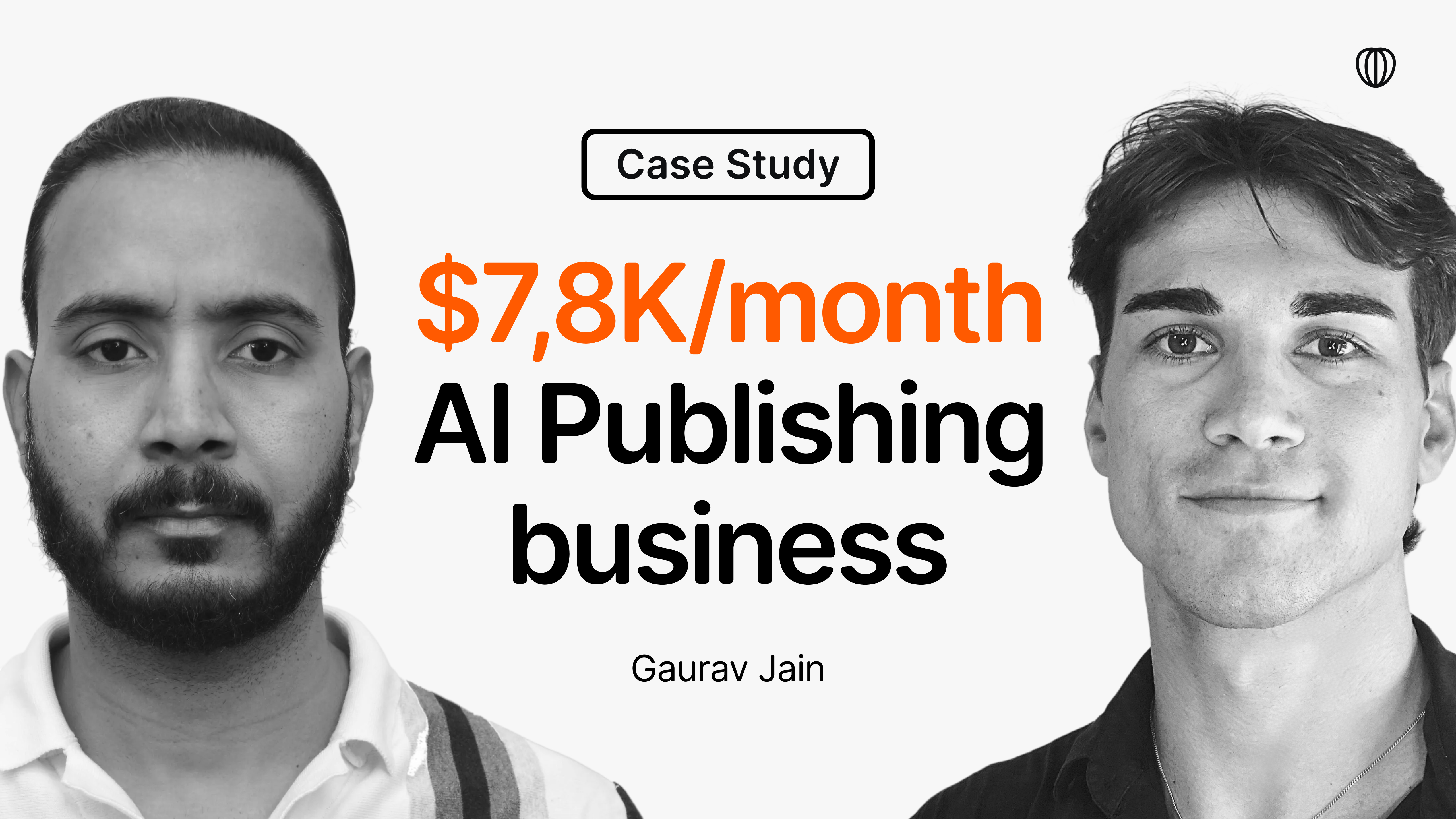
If you prefer “watching” over “reading” you can find the full 🎥 video version here!

Gaurav Jain spent 15 years in IT, designing solutions and optimizing customer experiences for enterprise clients. But when COVID-19 hit and he found himself working from home, he started thinking about a different kind of optimization: his own life.
He wanted time freedom. He wanted to watch his daughter grow up. He wanted to build something that didn't require him to trade hours for dollars. So he started publishing books on Amazon.
In May, he spent $1,400 on ads and made back $1,000. A $400 loss.
In June, he spent $2,400 and made back $1,800. A $600 loss.
Most people would have quit. Gaurav didn't.
By December, he was generating $7,800 in gross revenue and over $4,000 in net profit per month. In January—a notoriously slow month—he still pulled in $2,200 net.
Now he's targeting $10,000 per month in net profit by the end of the year. And he's spending just 10-12 hours per week managing the business.
This is a story about persistence, strategic thinking, and understanding that building a real business takes time—even when the early numbers say you should quit.
The IT Background: 15 Years of Problem-Solving
Gaurav didn't come from publishing. He came from IT. For 15 years, he worked in solution and service design, focusing on customer experience. He understood systems. He understood optimization. He understood how to solve complex problems.
But he also understood something else: no matter how good he got at his job, there was a ceiling. He could optimize processes for clients all day, but he couldn't optimize his own time.
When COVID-19 shifted his work to remote, he started thinking about what freedom actually meant. Not just financial freedom—time freedom. The ability to be present for his daughter while she was growing up. He started exploring online businesses. He had no background in publishing. No experience with Amazon. No idea how the book business worked.
Then he saw a post on Twitter from Tommi. It caught his attention. He started researching. And he realized: this was a low-risk way to learn a new skill and potentially build something that could give him the freedom he wanted.
Twelve months before the interview, he joined Publishing OS.
The First 90 Days: Losing Money and Learning
Gaurav's first few months were brutal. He was running ads without any profit for 60 to 90 days. He was spending more on advertising than he is now, because he was in the learning phase.
Here's what the numbers looked like:
- May: Spent $1,400 on ads, made back $1,000. [Loss: $400]
- June: Spent $2,400 on ads, made back $1,800. [Loss: $600.]
Most people would have stopped. They would have looked at those numbers and said, "This doesn't work." But Gaurav understood something most beginners don't: he wasn't losing money. He was investing in visibility.
"I was breaking even and I was content with not losing money while seeing improvements in ranking and BSR," he explains.
He wasn't looking for immediate profit. He was looking for signal. And the signal was there: his books were ranking. His BSR (Best Seller Rank) was improving. The system was working—it just needed time. This is the mindset that separates people who build businesses from people who chase quick wins.
The Turning Point: July to December
In July, Gaurav saw his first net profit: $200. It wasn't much. But it was proof. The system worked. He just needed to keep going.
Here's how the progression looked:
- July: $200 net profit
- August: $400 net profit
- October: $1,000 net profit
- November: $1,500 net profit
- December: $4,000 net profit
By December, he was generating $7,800 in gross revenue and over $4,000 in net profit. In January—a month when most publishers see a drop after the holiday season—he still pulled in $5,000 in gross revenue and $2,200 in net profit.
This wasn't luck. It was compounding. Every month, his books ranked higher. Every month, his organic sales increased. Every month, his ad spend became more efficient. And because he didn't quit in May or June, he was able to capture the upside in November and December.
The Strategy: Evergreen Topics and Healthy Margins
Gaurav's approach is methodical. He focuses on evergreen topics—niches with consistent demand year-round—and he optimizes ruthlessly for margin.
His target: a $7+ net margin per paperback copy.
Some of his books hit $8 to $8.50. Others are around $6. But the average is over $7, which gives him the buffer he needs to run ads profitably and scale.
Here's how he thinks about pricing:
- Ebooks: 70% royalty if priced between $2.99 and $9.99.
- Paperbacks: Approximately 50% royalty (60% minus printing costs). He aims for a $5+ net margin, preferably $7+.
This focus on margin is what allows him to reinvest in ads without bleeding money. And it's what makes his business scalable. He also reviews pricing regularly—every one to two weeks—comparing his books against competitors. If his BSR is strong and competitors are priced higher, he increases his price. If the market shifts, he adjusts. This isn't guesswork. It's data-driven optimization.
Diversification: Markets and Platforms
Gaurav doesn't rely on a single market or platform. His revenue is diversified across:
- United States: Primary market
- Canada: ~24% of royalties
- United Kingdom: ~$8,000 in royalties
- Australia: Growing market
This geographic diversification protects him from market-specific fluctuations. When one market slows down, another picks up. But he's not stopping there. This year, he's expanding into audiobooks. Why? Because it reduces his dependence on Amazon and opens new revenue streams on platforms like Spotify and other audiobook services.
He's also planning to publish 3-4 more books within his existing brands to establish them further. This isn't about chasing volume. It's about building depth in proven niches.
The Ads Manager Decision: Outsourcing to Scale
Initially, Gaurav managed his own ads. He learned the system. He understood how it worked. But he realized something: managing ads was taking time away from what he was actually good at—book production and creative strategy. So he hired an ads manager.
Now, he spends just 5-10 minutes per day monitoring ads. The manager handles the bulk of the work: optimizing bids, testing keywords, adjusting budgets. This freed up Gaurav to focus on higher-impact activities:
- Creating new books
- Researching new niches
- Planning diversification strategies
- Optimizing pricing and positioning
He now spends 10-12 hours per week on his publishing business. Most of that time goes to new book creation, strategy, and diversification—not ad management. This is strategic delegation. He's not outsourcing because he's lazy. He's outsourcing because it allows him to focus on the parts of the business that only he can do.
The Persistence Mindset: Why 99% Quit
When asked what made the difference, Gaurav's answer is simple: he didn't quit.
"99% of people would have stopped after losing money for two months," he says. "But I understood that this was part of the process."
He viewed the early losses not as failures, but as investments. He was paying for visibility. He was paying for ranking. He was paying to learn how the system worked. And because he kept going, he was able to capture the upside when the compounding kicked in. This is the mindset shift most beginners need. Publishing isn't a get-rich-quick scheme. It's a business. And businesses take time to build.
"Sometimes it can take more than expected to get to the result we want," Gaurav explains. "But if you understand that and you keep going, the results will come."
The Business Valuation: Building an Asset
Gaurav isn't just building income. He's building an asset. A business generating $4,000 in net profit per month can be sold for over $100,000. Businesses with consistent net profits in the $1,000 to $4,000+ range are considered easier to sell than those making very high but inconsistent profits. This means Gaurav has built something worth six figures in less than a year. And he's still scaling.
His goal for the year: $10,000 per month in net profit.
If he hits that, his business could be worth $300,000 or more.
This is the difference between treating publishing as a side hustle and treating it as a business. Side hustles generate income. Businesses generate assets.
Key Lessons for Beginners
If you're just starting out, here's what Gaurav's story teaches:
- Persistence is the differentiator.
Most people quit after the first loss. If you can push through the early months—even when you're losing money—you'll outlast 99% of the competition.
- Think in terms of visibility, not immediate profit.
Early ad spend is an investment in ranking and visibility. If your BSR is improving, you're on the right track—even if you're not profitable yet.
- Focus on evergreen topics and healthy margins.
Aim for a $7+ net margin per book. This gives you the buffer to run ads profitably and scale without bleeding money.
- Diversify early.
Don't rely on one market or one platform. Expand into Canada, the UK, Australia. Plan for audiobooks. Build multiple revenue streams.
- Outsource strategically.
Delegate tasks that aren't your core strength or that take too much time. Focus on what only you can do: strategy, book creation, and positioning.
- Review and optimize regularly.
Check your pricing every 1-2 weeks. Compare against competitors. Adjust based on BSR and market conditions.
- Understand the compounding effect.
Results take time. But once the flywheel starts spinning, the growth accelerates. You just have to stay in the game long enough to see it.
The 10-12 Hour Work Week
Gaurav now spends 10-12 hours per week on his publishing business. That's less than two hours per day. And he's generating $4,000+ per month in net profit. Compare that to his 15 years in IT, where he was trading 40+ hours per week for a salary with a ceiling.
Now, he has time freedom. He can be present for his daughter. He can work from anywhere. And he's building an asset that could be worth hundreds of thousands of dollars. This is what's possible when you treat publishing like a business, not a side hustle.
The Bigger Picture
Gaurav's story isn't about shortcuts or hacks. It's about persistence, strategic thinking, and understanding that building something valuable takes time.
He lost money for 90 days. Most people would have quit. He didn't. He invested in visibility when the numbers said he should stop. He kept going when the early results were discouraging. And he focused on the long game, not the quick win.
Now, he's generating $4,000+ per month in net profit, working 10-12 hours per week, and building an asset worth over $100,000.
For anyone stuck in a 9-to-5, wondering if there's another path, Gaurav's journey offers a clear answer: there is. But it requires patience, persistence, and the willingness to invest in yourself even when the early numbers don't look good.
The question is whether you're willing to push through the first 90 days—when most people quit—to capture the upside on the other side.
Gaurav Jain spent 15 years in IT, designing solutions and optimizing customer experiences for enterprise clients. But when COVID-19 hit and he found himself working from home, he started thinking about a different kind of optimization: his own life.
He wanted time freedom. He wanted to watch his daughter grow up. He wanted to build something that didn't require him to trade hours for dollars. So he started publishing books on Amazon.
In May, he spent $1,400 on ads and made back $1,000. A $400 loss.
In June, he spent $2,400 and made back $1,800. A $600 loss.
Most people would have quit. Gaurav didn't.
By December, he was generating $7,800 in gross revenue and over $4,000 in net profit per month. In January—a notoriously slow month—he still pulled in $2,200 net.
Now he's targeting $10,000 per month in net profit by the end of the year. And he's spending just 10-12 hours per week managing the business.
This is a story about persistence, strategic thinking, and understanding that building a real business takes time—even when the early numbers say you should quit.
The IT Background: 15 Years of Problem-Solving
Gaurav didn't come from publishing. He came from IT. For 15 years, he worked in solution and service design, focusing on customer experience. He understood systems. He understood optimization. He understood how to solve complex problems.
But he also understood something else: no matter how good he got at his job, there was a ceiling. He could optimize processes for clients all day, but he couldn't optimize his own time.
When COVID-19 shifted his work to remote, he started thinking about what freedom actually meant. Not just financial freedom—time freedom. The ability to be present for his daughter while she was growing up. He started exploring online businesses. He had no background in publishing. No experience with Amazon. No idea how the book business worked.
Then he saw a post on Twitter from Tommi. It caught his attention. He started researching. And he realized: this was a low-risk way to learn a new skill and potentially build something that could give him the freedom he wanted.
Twelve months before the interview, he joined Publishing OS.
The First 90 Days: Losing Money and Learning
Gaurav's first few months were brutal. He was running ads without any profit for 60 to 90 days. He was spending more on advertising than he is now, because he was in the learning phase.
Here's what the numbers looked like:
- May: Spent $1,400 on ads, made back $1,000. [Loss: $400]
- June: Spent $2,400 on ads, made back $1,800. [Loss: $600.]
Most people would have stopped. They would have looked at those numbers and said, "This doesn't work." But Gaurav understood something most beginners don't: he wasn't losing money. He was investing in visibility.
"I was breaking even and I was content with not losing money while seeing improvements in ranking and BSR," he explains.
He wasn't looking for immediate profit. He was looking for signal. And the signal was there: his books were ranking. His BSR (Best Seller Rank) was improving. The system was working—it just needed time. This is the mindset that separates people who build businesses from people who chase quick wins.
The Turning Point: July to December
In July, Gaurav saw his first net profit: $200. It wasn't much. But it was proof. The system worked. He just needed to keep going.
Here's how the progression looked:
- July: $200 net profit
- August: $400 net profit
- October: $1,000 net profit
- November: $1,500 net profit
- December: $4,000 net profit
By December, he was generating $7,800 in gross revenue and over $4,000 in net profit. In January—a month when most publishers see a drop after the holiday season—he still pulled in $5,000 in gross revenue and $2,200 in net profit.
This wasn't luck. It was compounding. Every month, his books ranked higher. Every month, his organic sales increased. Every month, his ad spend became more efficient. And because he didn't quit in May or June, he was able to capture the upside in November and December.
The Strategy: Evergreen Topics and Healthy Margins
Gaurav's approach is methodical. He focuses on evergreen topics—niches with consistent demand year-round—and he optimizes ruthlessly for margin.
His target: a $7+ net margin per paperback copy.
Some of his books hit $8 to $8.50. Others are around $6. But the average is over $7, which gives him the buffer he needs to run ads profitably and scale.
Here's how he thinks about pricing:
- Ebooks: 70% royalty if priced between $2.99 and $9.99.
- Paperbacks: Approximately 50% royalty (60% minus printing costs). He aims for a $5+ net margin, preferably $7+.
This focus on margin is what allows him to reinvest in ads without bleeding money. And it's what makes his business scalable. He also reviews pricing regularly—every one to two weeks—comparing his books against competitors. If his BSR is strong and competitors are priced higher, he increases his price. If the market shifts, he adjusts. This isn't guesswork. It's data-driven optimization.
Diversification: Markets and Platforms
Gaurav doesn't rely on a single market or platform. His revenue is diversified across:
- United States: Primary market
- Canada: ~24% of royalties
- United Kingdom: ~$8,000 in royalties
- Australia: Growing market
This geographic diversification protects him from market-specific fluctuations. When one market slows down, another picks up. But he's not stopping there. This year, he's expanding into audiobooks. Why? Because it reduces his dependence on Amazon and opens new revenue streams on platforms like Spotify and other audiobook services.
He's also planning to publish 3-4 more books within his existing brands to establish them further. This isn't about chasing volume. It's about building depth in proven niches.
The Ads Manager Decision: Outsourcing to Scale
Initially, Gaurav managed his own ads. He learned the system. He understood how it worked. But he realized something: managing ads was taking time away from what he was actually good at—book production and creative strategy. So he hired an ads manager.
Now, he spends just 5-10 minutes per day monitoring ads. The manager handles the bulk of the work: optimizing bids, testing keywords, adjusting budgets. This freed up Gaurav to focus on higher-impact activities:
- Creating new books
- Researching new niches
- Planning diversification strategies
- Optimizing pricing and positioning
He now spends 10-12 hours per week on his publishing business. Most of that time goes to new book creation, strategy, and diversification—not ad management. This is strategic delegation. He's not outsourcing because he's lazy. He's outsourcing because it allows him to focus on the parts of the business that only he can do.
The Persistence Mindset: Why 99% Quit
When asked what made the difference, Gaurav's answer is simple: he didn't quit.
"99% of people would have stopped after losing money for two months," he says. "But I understood that this was part of the process."
He viewed the early losses not as failures, but as investments. He was paying for visibility. He was paying for ranking. He was paying to learn how the system worked. And because he kept going, he was able to capture the upside when the compounding kicked in. This is the mindset shift most beginners need. Publishing isn't a get-rich-quick scheme. It's a business. And businesses take time to build.
"Sometimes it can take more than expected to get to the result we want," Gaurav explains. "But if you understand that and you keep going, the results will come."
The Business Valuation: Building an Asset
Gaurav isn't just building income. He's building an asset. A business generating $4,000 in net profit per month can be sold for over $100,000. Businesses with consistent net profits in the $1,000 to $4,000+ range are considered easier to sell than those making very high but inconsistent profits. This means Gaurav has built something worth six figures in less than a year. And he's still scaling.
His goal for the year: $10,000 per month in net profit.
If he hits that, his business could be worth $300,000 or more.
This is the difference between treating publishing as a side hustle and treating it as a business. Side hustles generate income. Businesses generate assets.
Key Lessons for Beginners
If you're just starting out, here's what Gaurav's story teaches:
- Persistence is the differentiator.
Most people quit after the first loss. If you can push through the early months—even when you're losing money—you'll outlast 99% of the competition.
- Think in terms of visibility, not immediate profit.
Early ad spend is an investment in ranking and visibility. If your BSR is improving, you're on the right track—even if you're not profitable yet.
- Focus on evergreen topics and healthy margins.
Aim for a $7+ net margin per book. This gives you the buffer to run ads profitably and scale without bleeding money.
- Diversify early.
Don't rely on one market or one platform. Expand into Canada, the UK, Australia. Plan for audiobooks. Build multiple revenue streams.
- Outsource strategically.
Delegate tasks that aren't your core strength or that take too much time. Focus on what only you can do: strategy, book creation, and positioning.
- Review and optimize regularly.
Check your pricing every 1-2 weeks. Compare against competitors. Adjust based on BSR and market conditions.
- Understand the compounding effect.
Results take time. But once the flywheel starts spinning, the growth accelerates. You just have to stay in the game long enough to see it.
The 10-12 Hour Work Week
Gaurav now spends 10-12 hours per week on his publishing business. That's less than two hours per day. And he's generating $4,000+ per month in net profit. Compare that to his 15 years in IT, where he was trading 40+ hours per week for a salary with a ceiling.
Now, he has time freedom. He can be present for his daughter. He can work from anywhere. And he's building an asset that could be worth hundreds of thousands of dollars. This is what's possible when you treat publishing like a business, not a side hustle.
The Bigger Picture
Gaurav's story isn't about shortcuts or hacks. It's about persistence, strategic thinking, and understanding that building something valuable takes time.
He lost money for 90 days. Most people would have quit. He didn't. He invested in visibility when the numbers said he should stop. He kept going when the early results were discouraging. And he focused on the long game, not the quick win.
Now, he's generating $4,000+ per month in net profit, working 10-12 hours per week, and building an asset worth over $100,000.
For anyone stuck in a 9-to-5, wondering if there's another path, Gaurav's journey offers a clear answer: there is. But it requires patience, persistence, and the willingness to invest in yourself even when the early numbers don't look good.
The question is whether you're willing to push through the first 90 days—when most people quit—to capture the upside on the other side.