January 30, 2026
How a Former Investment Banker Built a $300K Publishing Business in 4 Years
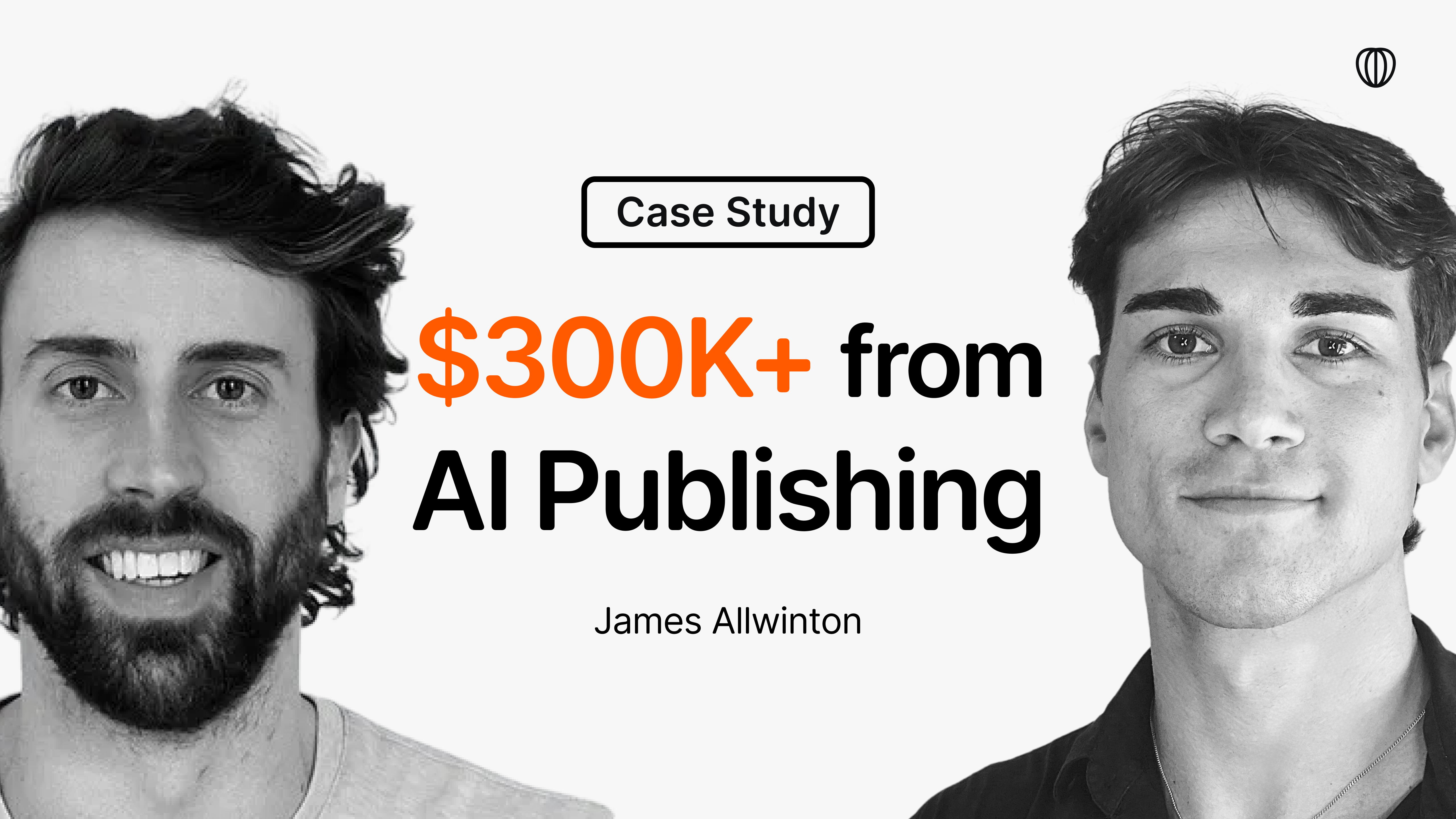
If you prefer “watching” over “reading” you can find the full 🎥 video version here!

James spent eight years at an investment bank before he realized something: no matter how well he performed, there was a ceiling to what he could earn. He wanted to build something of his own. Something where the outcomes depended entirely on him. So he started exploring business models—affiliate marketing, drop shipping, e-commerce. He tried a few. Failed at a few. Then he discovered Kindle Direct Publishing.
Four years later, he's earned over $200,000 from KDP alone, plus another $70,000 to $100,000 from Audible and $30,000+ from other platforms. He quit his job two years ago and now runs his publishing business full-time.
But here's what makes his story different: one of his accounts generates $4,000 to $5,000 per month in profit—and he spends just four hours per month managing it. This is a story about building assets that compound, simplifying ruthlessly, and understanding what actually matters in a business where most people get distracted by the wrong things.
Why Publishing Over Everything Else
James didn't choose publishing randomly. He evaluated multiple business models and kept coming back to three things that mattered to him.
First, anonymity. While working at the bank, he didn't want to be the face of anything. Publishing allowed him to build quietly.
Second, scalability. He saw people making serious money on KDP—not just side income, but life-changing revenue. The earning potential was real.
Third, low capital requirements. Unlike e-commerce or traditional businesses, he didn't need a massive upfront investment. And looking back, he believes starting with less money would have been better. "I had savings when I quit my job, and I think that slowed down my progress," he explains. "It was only once I used a lot of my savings that I was like, right, I really need to make this work." With AI tools now available, the barrier to entry is even lower. You can start with almost nothing.
The First Two Years: Learning What Works
James didn't have any dramatic breakthroughs. No single book that changed everything overnight. Instead, he experienced what he calls "little wins" that compounded over time.
He published books that made no money. He published books that made some money. He learned what worked and what didn't. He refined his process, improved his covers, sharpened his keyword research, and got better at understanding what readers actually wanted.
"You've got to publish a whole bunch of books that don't make any money before you realize what works," he says.
The key was consistency. He put in work every day. He never took big breaks. And every so often, those little wins would add up. When he looked back over a year or two, he realized how far he'd come. But the real shift happened when he stopped trying to do everything himself and started delegating.
What to Delegate First
The first thing James outsourced was writing. This was before AI became accessible, so he hired ghostwriters to handle the content while he focused on outlines, research, and strategy.
Now, with AI, nearly everything can be automated: outlines, writing, keyword research, marketing materials, formatting. The only thing he hasn't fully automated yet is cover design—but he believes that's coming soon.
"All we're really doing is creating an original PDF that people like and uploading it to the platform and then sending traffic to that platform," he explains. "If you do those things really well, then you're going to make a lot of money."
And all of those things are well within Amazon's rules. There's no need to game the system or take shortcuts. The path to real success is straightforward: create quality, find the right audience, and drive traffic.
The Practice Portfolio Strategy
James has published dozens of books, but here's what most people miss: he treats the majority of them as practice. Out of all his titles, only 20 to 30 generate the bulk of his income. The rest? They're his training ground. Each book he publishes—whether it makes money or not—teaches him something about covers, keywords, marketing angles, and what resonates with readers. He's not hoping for random hits. He's deliberately building expertise.
When he identifies a high-demand topic that deserves serious investment—maybe one that needs a human writer instead of AI—he's already battle-tested. He's refined his cover design through dozens of iterations. He's mastered his marketing copy. He knows exactly which keywords convert. So when he launches that bigger project, it doesn't feel like a gamble. It's the culmination of everything he's learned.
This is what separates publishers who scale from those who stall: they understand that most books are stepping stones, not destinations. The real asset isn't any single book—it's the system you build by publishing consistently.
The Four-Hour-Per-Month Account
One of James's accounts is almost entirely outsourced. He spends roughly four hours per month on it, and it generates $4,000 to $5,000 in profit.
To put that in perspective: in the traditional world, you'd need a real estate property worth half a million dollars to generate that kind of passive income.
He's working to outsource even those last four hours. Everything is process-driven. Everything can be systematized. But he's not sitting idle. He's spending his time on bigger projects—building an email list, running Meta ads, and scaling his business to the next level.
The Shift to Simplification
James's plan for this year is counterintuitive: simplify.
He's running multiple pen names, managing ads for some books but not others, trying to get reviews across a scattered portfolio. And he's realized that even this level of complexity is holding him back. So he's consolidating. Moving down to one or two pen names. Focusing on one niche. Making the books really good.
"I think that will take me to the next level," he says.
This is a lesson most entrepreneurs learn the hard way: more isn't always better. Focus compounds. Simplicity scales.
What AI Changed
James started publishing before AI became accessible. He paid ghostwriters. He spent heavily on content creation. And while he built a successful business, the costs were significant.
Now, with AI, the game has changed entirely. AI can handle research by downloading data from Reddit, YouTube, and other platforms, then summarizing it to identify the dream outcome readers want and the pain points they're experiencing. It can craft the perfect title, write marketing copy, generate outlines, and even write the book itself—especially for simpler topics.
James uses Claude for writing and calls the quality "incredible." For topics that require a human touch, he still hires writers. But for the majority of his books, AI handles the heavy lifting.
"Anyone starting KDP right now is so lucky with AI," he says.
"You can make money with zero cost."
The Biggest Mistakes Beginners Make
James sees two major mistakes that hold people back.
The first is overthinking. Beginners get stuck trying to make everything perfect before they publish. They stress about bad reviews. They hesitate to take action. His advice: keep costs low, publish quickly, and get some money coming in. Don't overthink it. Just get books out.
The second mistake is focusing on the wrong things. Too many people obsess over minor details while ignoring what actually drives success: topic selection, marketing, and Amazon ads. "The really important parts are the topic selection, the marketing, and then the Amazon ads," he explains. "Those are the most important parts of the process." If you're not publishing books, you're not making money. And if you're not learning from each launch, you're not improving.
The Platform Dependency Question
One of the biggest concerns people have about publishing is platform dependency. If Amazon terminates your account, you're in trouble. But James sees this differently.
"If you're picking topics by copying other people's books and getting reviews in illegitimate ways, then those are the things that are going to get you banned," he says. "But that's not the way to make really big money."
The path to real success is well within Amazon's rules: create an original, high-quality book that people like, upload it to the platform, and send traffic to it. If you do those things well, Amazon will never ban you. And you'll make a lot of money.
What's Next
James's focus this year is building an email list. He believes this is the key to reaching $30,000, $50,000, even $100,000 per month.
An email list solves multiple problems. It helps with organic ranking on Amazon. It generates reviews. And it gives him direct access to his audience, reducing his dependence on any single platform. He's running Meta ads on Facebook to build the list, and he's confident this will push his earnings to the next level.
In terms of how he's allocating his money, his strategy has shifted. For the first few years, he reinvested everything back into publishing. Now, he's focused on maximizing profit and keeping costs as low as possible. Every spending decision is filtered through one question: do I need to spend this money, and if so, what's the cheapest way to do it?
He's taking cash out of the business, keeping some liquid, and putting some into Bitcoin. And for his new project this year, he's reinvesting in Meta ads and Amazon ads—the two channels that drive the most growth.
The Takeaway
James's story isn't about shortcuts or hacks. It's about understanding what matters, focusing relentlessly on those things, and letting the results compound over time. He didn't have a single breakthrough moment. He had hundreds of small wins that added up. He published books that failed. He learned from them. He got better.
And now, four years later, he's built a business that pays him well, gives him freedom, and continues to grow.
For anyone stuck in a job with a ceiling, wondering if there's another way, James's journey offers a clear answer: there is. But it requires focus, consistency, and a willingness to publish even when you're not sure it will work. The tools are better than ever. The opportunity is real. The question is whether you're ready to start.
James spent eight years at an investment bank before he realized something: no matter how well he performed, there was a ceiling to what he could earn. He wanted to build something of his own. Something where the outcomes depended entirely on him. So he started exploring business models—affiliate marketing, drop shipping, e-commerce. He tried a few. Failed at a few. Then he discovered Kindle Direct Publishing.
Four years later, he's earned over $200,000 from KDP alone, plus another $70,000 to $100,000 from Audible and $30,000+ from other platforms. He quit his job two years ago and now runs his publishing business full-time.
But here's what makes his story different: one of his accounts generates $4,000 to $5,000 per month in profit—and he spends just four hours per month managing it. This is a story about building assets that compound, simplifying ruthlessly, and understanding what actually matters in a business where most people get distracted by the wrong things.
Why Publishing Over Everything Else
James didn't choose publishing randomly. He evaluated multiple business models and kept coming back to three things that mattered to him.
First, anonymity. While working at the bank, he didn't want to be the face of anything. Publishing allowed him to build quietly.
Second, scalability. He saw people making serious money on KDP—not just side income, but life-changing revenue. The earning potential was real.
Third, low capital requirements. Unlike e-commerce or traditional businesses, he didn't need a massive upfront investment. And looking back, he believes starting with less money would have been better. "I had savings when I quit my job, and I think that slowed down my progress," he explains. "It was only once I used a lot of my savings that I was like, right, I really need to make this work." With AI tools now available, the barrier to entry is even lower. You can start with almost nothing.
The First Two Years: Learning What Works
James didn't have any dramatic breakthroughs. No single book that changed everything overnight. Instead, he experienced what he calls "little wins" that compounded over time.
He published books that made no money. He published books that made some money. He learned what worked and what didn't. He refined his process, improved his covers, sharpened his keyword research, and got better at understanding what readers actually wanted.
"You've got to publish a whole bunch of books that don't make any money before you realize what works," he says.
The key was consistency. He put in work every day. He never took big breaks. And every so often, those little wins would add up. When he looked back over a year or two, he realized how far he'd come. But the real shift happened when he stopped trying to do everything himself and started delegating.
What to Delegate First
The first thing James outsourced was writing. This was before AI became accessible, so he hired ghostwriters to handle the content while he focused on outlines, research, and strategy.
Now, with AI, nearly everything can be automated: outlines, writing, keyword research, marketing materials, formatting. The only thing he hasn't fully automated yet is cover design—but he believes that's coming soon.
"All we're really doing is creating an original PDF that people like and uploading it to the platform and then sending traffic to that platform," he explains. "If you do those things really well, then you're going to make a lot of money."
And all of those things are well within Amazon's rules. There's no need to game the system or take shortcuts. The path to real success is straightforward: create quality, find the right audience, and drive traffic.
The Practice Portfolio Strategy
James has published dozens of books, but here's what most people miss: he treats the majority of them as practice. Out of all his titles, only 20 to 30 generate the bulk of his income. The rest? They're his training ground. Each book he publishes—whether it makes money or not—teaches him something about covers, keywords, marketing angles, and what resonates with readers. He's not hoping for random hits. He's deliberately building expertise.
When he identifies a high-demand topic that deserves serious investment—maybe one that needs a human writer instead of AI—he's already battle-tested. He's refined his cover design through dozens of iterations. He's mastered his marketing copy. He knows exactly which keywords convert. So when he launches that bigger project, it doesn't feel like a gamble. It's the culmination of everything he's learned.
This is what separates publishers who scale from those who stall: they understand that most books are stepping stones, not destinations. The real asset isn't any single book—it's the system you build by publishing consistently.
The Four-Hour-Per-Month Account
One of James's accounts is almost entirely outsourced. He spends roughly four hours per month on it, and it generates $4,000 to $5,000 in profit.
To put that in perspective: in the traditional world, you'd need a real estate property worth half a million dollars to generate that kind of passive income.
He's working to outsource even those last four hours. Everything is process-driven. Everything can be systematized. But he's not sitting idle. He's spending his time on bigger projects—building an email list, running Meta ads, and scaling his business to the next level.
The Shift to Simplification
James's plan for this year is counterintuitive: simplify.
He's running multiple pen names, managing ads for some books but not others, trying to get reviews across a scattered portfolio. And he's realized that even this level of complexity is holding him back. So he's consolidating. Moving down to one or two pen names. Focusing on one niche. Making the books really good.
"I think that will take me to the next level," he says.
This is a lesson most entrepreneurs learn the hard way: more isn't always better. Focus compounds. Simplicity scales.
What AI Changed
James started publishing before AI became accessible. He paid ghostwriters. He spent heavily on content creation. And while he built a successful business, the costs were significant.
Now, with AI, the game has changed entirely. AI can handle research by downloading data from Reddit, YouTube, and other platforms, then summarizing it to identify the dream outcome readers want and the pain points they're experiencing. It can craft the perfect title, write marketing copy, generate outlines, and even write the book itself—especially for simpler topics.
James uses Claude for writing and calls the quality "incredible." For topics that require a human touch, he still hires writers. But for the majority of his books, AI handles the heavy lifting.
"Anyone starting KDP right now is so lucky with AI," he says.
"You can make money with zero cost."
The Biggest Mistakes Beginners Make
James sees two major mistakes that hold people back.
The first is overthinking. Beginners get stuck trying to make everything perfect before they publish. They stress about bad reviews. They hesitate to take action. His advice: keep costs low, publish quickly, and get some money coming in. Don't overthink it. Just get books out.
The second mistake is focusing on the wrong things. Too many people obsess over minor details while ignoring what actually drives success: topic selection, marketing, and Amazon ads. "The really important parts are the topic selection, the marketing, and then the Amazon ads," he explains. "Those are the most important parts of the process." If you're not publishing books, you're not making money. And if you're not learning from each launch, you're not improving.
The Platform Dependency Question
One of the biggest concerns people have about publishing is platform dependency. If Amazon terminates your account, you're in trouble. But James sees this differently.
"If you're picking topics by copying other people's books and getting reviews in illegitimate ways, then those are the things that are going to get you banned," he says. "But that's not the way to make really big money."
The path to real success is well within Amazon's rules: create an original, high-quality book that people like, upload it to the platform, and send traffic to it. If you do those things well, Amazon will never ban you. And you'll make a lot of money.
What's Next
James's focus this year is building an email list. He believes this is the key to reaching $30,000, $50,000, even $100,000 per month.
An email list solves multiple problems. It helps with organic ranking on Amazon. It generates reviews. And it gives him direct access to his audience, reducing his dependence on any single platform. He's running Meta ads on Facebook to build the list, and he's confident this will push his earnings to the next level.
In terms of how he's allocating his money, his strategy has shifted. For the first few years, he reinvested everything back into publishing. Now, he's focused on maximizing profit and keeping costs as low as possible. Every spending decision is filtered through one question: do I need to spend this money, and if so, what's the cheapest way to do it?
He's taking cash out of the business, keeping some liquid, and putting some into Bitcoin. And for his new project this year, he's reinvesting in Meta ads and Amazon ads—the two channels that drive the most growth.
The Takeaway
James's story isn't about shortcuts or hacks. It's about understanding what matters, focusing relentlessly on those things, and letting the results compound over time. He didn't have a single breakthrough moment. He had hundreds of small wins that added up. He published books that failed. He learned from them. He got better.
And now, four years later, he's built a business that pays him well, gives him freedom, and continues to grow.
For anyone stuck in a job with a ceiling, wondering if there's another way, James's journey offers a clear answer: there is. But it requires focus, consistency, and a willingness to publish even when you're not sure it will work. The tools are better than ever. The opportunity is real. The question is whether you're ready to start.