February 6, 2026
From $300 a Month to a $1M Exit: How Two Publishers Cracked the Code in Under a Year
If you prefer “watching” over “reading” you can find the full 🎥 video version here!

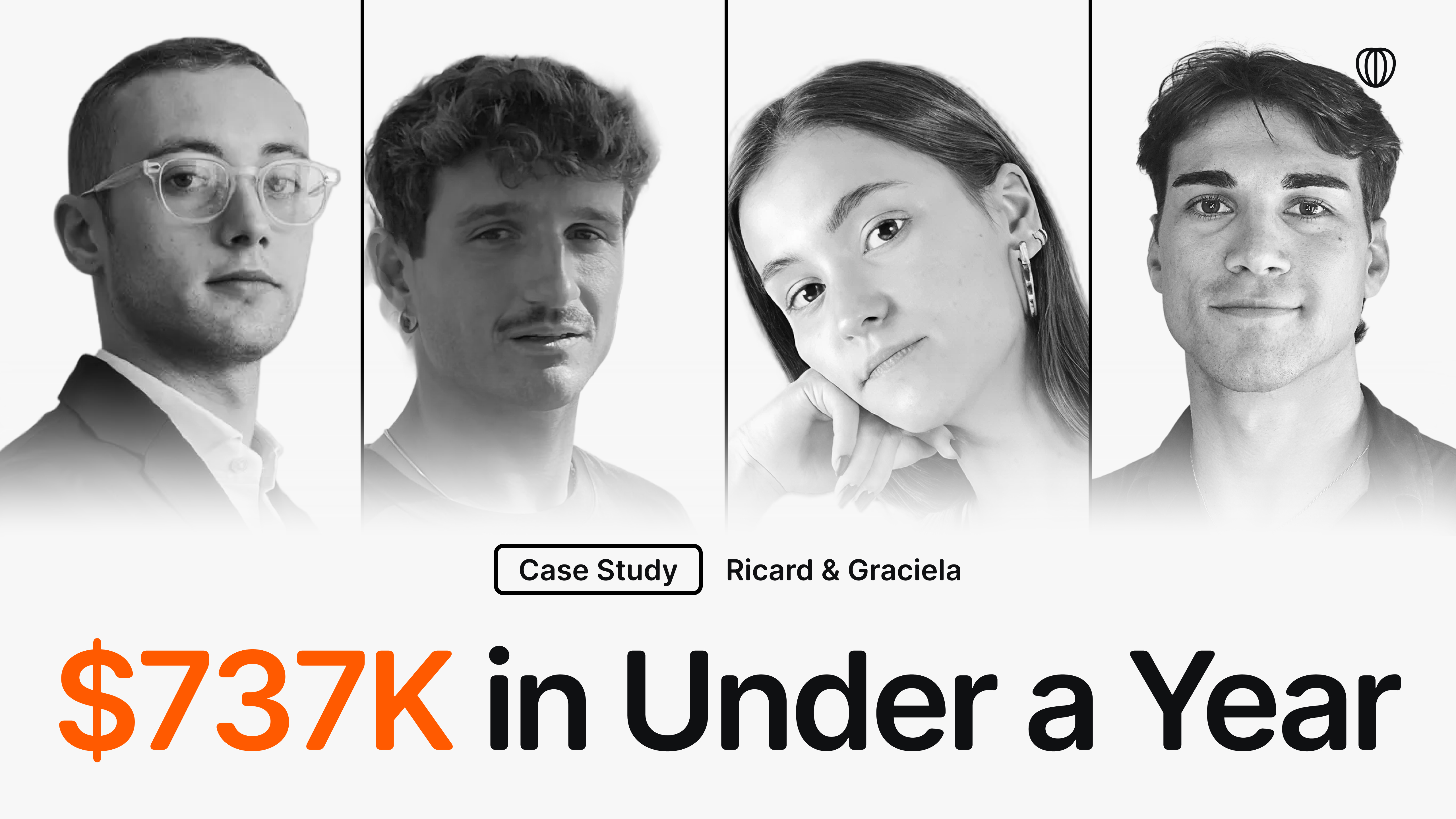
Ricard was making $300 a month from publishing when he met Graciela. Less than a year later, they generated $737,000 in royalties. One book alone brought in $329,000 in 90 days. Their 2025 Q4 performance? $393,000 in three months. Now they're selling the business for over $1 million.
This isn't a story about luck or timing. It's about two people who understood something most publishers miss: niche research matters more than everything else combined. And when you find the right niche at the right time, you don't need dozens of books. You need the right ones.
Ricard and Graciela published 12 books. Ten of them were profitable. But the real money came from understanding trends, optimizing covers, and moving fast when they spotted an opportunity.
This is a story about strategic execution, collaborative momentum, and knowing when to exit at the peak.
The Setup: Living and Building Together
Ricard had been in KDP for about two years before meeting Graciela. He was earning around $300 per month—enough to validate the model, but not enough to change his life.
Graciela is the sister of Ricard's partner, Sandra. The three of them moved to Australia together, and that living arrangement became the foundation of their business success.
They weren't just roommates. They were collaborators. They shared niche research. They analyzed trends together. They tested ideas in real-time.
This collaborative environment accelerated everything. When one person found a promising niche, the others could validate it immediately. When a book performed well, they could replicate the strategy across new topics.
Ricard became a mentor figure to Graciela. He taught her what he'd learned about niche research, cover design, and market analysis. And together, they built something neither could have built alone.
The Breakthrough: One Book, $329K in 90 Days
Their second book on the account changed everything. Within two to three months of publication, it was generating $20,000 per month in profit. But that was just the beginning. By Q4, that single book had generated $329,000 in royalties in less than 90 days. The net profit? $231,000. That's over a 70% profit margin.
Here's the month-by-month breakdown for that book:
- July (launch month): $5,000 net royalties, $13,000 gross profit (7% profit margin, $5,000 ad spend)
- August: $21,000 net royalties ($8,000 ad spend)
- September: $18,000 net royalties
- October: $50,000 net royalties
- November: $77,000 net royalties
- December: $93,000 net royalties (their highest month)
In just five months (July to November), that book generated $125,000 in net royalties. By December, it hit $93,000 in a single month. This wasn't a fluke. It was the result of finding the right niche at the right time and executing flawlessly.
The 2025 Q4 Performance: $393K in Three Months
Q4 is when everything compounded. From October 1st to December 31st, they generated approximately $393,000 in royalties:
- October: $100,000
- November: $144,000
- December: $141,000
This wasn't just from one book. They had 10 profitable books out of 12 published. But the majority of the revenue came from their top performers—books that hit the right trends at the right time.
Their total lifetime earnings from KDP, in less than a year, reached $737,000. And now they're selling the business for over $1 million, with a valuation multiplier of 30-35 times monthly earnings.
The Strategy: Niche Research Above Everything
When asked what made the difference, Ricard's answer is immediate: niche research.
"Niche research is super, super important," he explains. "Finding the good niche at the good time, good spot. Super important."
This isn't about picking a broad category and hoping for the best. It's about analyzing the market, identifying trends, and understanding what people are searching for right now. They spend hours analyzing data. They use tools like Helium 10 to check keyword volume and BSR (Best Seller Rank). They look for books with high review counts, which signals sustained demand.
But here's the key: they're not just looking for evergreen niches. They're looking for trends that are happening now—especially around Q4—that also have evergreen potential. When they find a highly valuable niche, they move fast. They can launch a high-quality book within a week, sometimes even a day. They abandon other projects to focus on the opportunity in front of them.
This is the difference between publishers who make money and publishers who make life-changing money. Speed matters. But only when it's paired with the right niche.
The Cover is Everything
Ricard is emphatic about this: "The cover is the most crucial part of the publication process."
They've seen it firsthand. A book with mediocre sales can be turned around overnight just by changing the cover. Their process for cover design is methodical:
- Use AI prompts to generate ideas, styles, and color palettes.
- Analyze what's working in the niche—not to copy, but to understand what resonates.
- Make it 3-5% better. You don't need to reinvent the wheel. You just need to be slightly better than what's already selling.
- Test and iterate. If a cover isn't performing, they change it. Fast.
Sometimes they reuse elements from failed projects, adapting them for new niches. Sometimes they hire designers to create a version that's "3% better" or "5% better" than what they could do themselves. The result? Books that stand out in a crowded market and convert browsers into buyers.
"You don't need to reinvent the wheel," Ricard says. "You can take inspiration within the same niche, make it better, 3% better, 5% better. Man, you're gonna sell a lot."
The AI Advantage: Speed Without Sacrificing Quality
Ricard and Graciela leverage AI at every stage of the process. They use AI prompts for:
- Titles
- Descriptions
- Book cover design concepts
- Outlines
- Manuscripts
This dramatically reduces production costs and time. They've created bestsellers in a single day using AI workflows.
But they're clear about one thing: AI is a tool, not a replacement for judgment. They still review everything. They still optimize. They still ensure the final product is high quality.The difference is that what used to take weeks now takes days. And that speed allows them to capitalize on trends before the market shifts.
Replication: Once It Works, Do It Again
When they find a strategy or cover that works, they replicate it. They make minor changes—adjusting the color palette, tweaking the title, adapting the design for a new niche. But the core formula stays the same. This is how they scaled from one successful book to ten profitable books in less than a year. They didn't start from scratch every time. They built on what was already working.
And because they were collaborating, they could test variations faster. One person could focus on niche research while the other optimized covers. They could launch multiple books in parallel without bottlenecking on a single skill set.
The Lean Business Model
One of the reasons they moved so fast is because KDP is a lean business.
"Amazon KDP is a very lean business," Ricard explains. "We don't have our house with 2,000 books that we need to sell with a bad cover. Just by changing one component, that is the book cover, you can spend $50... or you can do it with our prompt."
No inventory. No warehouses. No customer service. No shipping logistics. All they need to do is publish a good product that customers love. Amazon handles the rest. This simplicity allowed them to focus entirely on what matters: finding the right niches, creating the right books, and optimizing for conversions.
The Initial Investment: $38K-$43K
Ricard didn't start with nothing. He had savings, and he asked his parents for help. He received €20,000 from his parents and added another €15,000-€20,000 of his own for ad spend. Total initial investment: approximately €35,000-€40,000 (around $38,000-$43,000).
But here's the important part: they reinvested everything.
Every dollar they made went back into the business—primarily for ad spend. This allowed them to scale aggressively, especially during Q4 when the ROI on ads was highest.
"Reinvest all your profits back into the business, particularly for ad spend, to fuel growth," Ricard advises.
This is how they went from $300 a month to $737,000 in less than a year. They didn't take profits out. They compounded them.
The Mentorship Factor
Ricard and Graciela are part of the Publishing OS community, and they credit Manu as a key mentor. Ricard joined the community around November 2024, and the guidance he received accelerated his progress.
"When you don't have money and you start, every course that you find, I do think that it's absolutely super expensive," he says. "But when you see backwards, you see and you say, that was the cheapest thing that I have ever paid because, I mean, you have saved a lot of time."
The lesson: invest in learning. The right guidance compresses years of trial and error into months of focused execution.
"If you start and you learn in an active community with good mentors, you can be successful in midterm 100%," Ricard says.
Why They're Selling at Over $1 Million
Most people would hold onto a business generating $737,000 in less than a year. But Ricard and Graciela are selling. The business is valued at over $1 million, with a multiplier of 30-35 times monthly earnings. They're timing the exit strategically, selling when the business is at peak performance.
Why? Because they understand something most entrepreneurs don't: the best time to sell is when you don't have to. Selling now gives them capital to invest in bigger projects. It frees them from the operational weight of managing the current portfolio. And it allows them to start fresh with everything they've learned.
"The less rigid you are, the better it is for selling faster," Ricard notes.
They're not clinging to the business. They're treating it as an asset—one they built, optimized, and are now cashing out at the top.
The Collaborative Advantage
One of their biggest strengths is how they work together. Ricard focuses on niche research and data analysis. Graciela handles production and execution. Together, they can move faster than either could alone.
They share ideas in real-time. They validate niches together. They test strategies in parallel.
This collaborative dynamic is what allowed them to publish 12 books and have 10 of them be profitable. They weren't guessing. They were systematically testing, learning, and scaling.
"It is insane how with the right guidance... but also the right mindset... the right commitment and the right system... your portfolio can grow and doesn't rely on your willpower or if today I want to work or not. With the system, plug and play, the business is going to grow anyway," Ricard says.
Key Lessons for New Publishers
If you're just starting out, here's what Ricard and Graciela's story teaches:
- Niche research is the foundation.
You can have the best cover, the best content, and the best ads. But if you're in the wrong niche, none of it matters. Spend time finding the right opportunity.
- The cover is the most crucial part.
A great cover can turn a mediocre book into a bestseller. A bad cover will kill even the best content. Invest in getting this right.
- Speed matters—but only when paired with the right niche.
When you find a high-value opportunity, move fast. Launch quickly. Test the market. Don't wait for perfection.
- Reinvest everything.
The fastest way to scale is to put every dollar back into the business. Especially in the early stages, reinvestment compounds faster than anything else.
- Leverage AI, but don't skip quality control.
AI can compress weeks of work into days. But you still need to review, optimize, and ensure the final product is something customers will love.
- Collaboration accelerates everything.
If you can work with someone who complements your skills, you'll move faster and make fewer mistakes.
- Know when to exit.
Building a business is valuable. But knowing when to sell and capture that value is just as important.
The Bigger Picture
Ricard and Graciela's story isn't just about making money from books. It's about understanding leverage. They leveraged niche research to find the right opportunities. They leveraged AI to create books faster. They leveraged collaboration to execute at scale. And now they're leveraging their success to fund the next chapter.
This is what separates people who make money from people who build wealth. It's not about holding on. It's about knowing when to capture value and reinvest it strategically.
The tools are accessible. The market is still early. The opportunity is real.
The question is whether you're ready to treat publishing like a business—and build something worth selling.
Ricard was making $300 a month from publishing when he met Graciela. Less than a year later, they generated $737,000 in royalties. One book alone brought in $329,000 in 90 days. Their 2025 Q4 performance? $393,000 in three months. Now they're selling the business for over $1 million.
This isn't a story about luck or timing. It's about two people who understood something most publishers miss: niche research matters more than everything else combined. And when you find the right niche at the right time, you don't need dozens of books. You need the right ones.
Ricard and Graciela published 12 books. Ten of them were profitable. But the real money came from understanding trends, optimizing covers, and moving fast when they spotted an opportunity.
This is a story about strategic execution, collaborative momentum, and knowing when to exit at the peak.
The Setup: Living and Building Together
Ricard had been in KDP for about two years before meeting Graciela. He was earning around $300 per month—enough to validate the model, but not enough to change his life.
Graciela is the sister of Ricard's partner, Sandra. The three of them moved to Australia together, and that living arrangement became the foundation of their business success.
They weren't just roommates. They were collaborators. They shared niche research. They analyzed trends together. They tested ideas in real-time.
This collaborative environment accelerated everything. When one person found a promising niche, the others could validate it immediately. When a book performed well, they could replicate the strategy across new topics.
Ricard became a mentor figure to Graciela. He taught her what he'd learned about niche research, cover design, and market analysis. And together, they built something neither could have built alone.
The Breakthrough: One Book, $329K in 90 Days
Their second book on the account changed everything. Within two to three months of publication, it was generating $20,000 per month in profit. But that was just the beginning. By Q4, that single book had generated $329,000 in royalties in less than 90 days. The net profit? $231,000. That's over a 70% profit margin.
Here's the month-by-month breakdown for that book:
- July (launch month): $5,000 net royalties, $13,000 gross profit (7% profit margin, $5,000 ad spend)
- August: $21,000 net royalties ($8,000 ad spend)
- September: $18,000 net royalties
- October: $50,000 net royalties
- November: $77,000 net royalties
- December: $93,000 net royalties (their highest month)
In just five months (July to November), that book generated $125,000 in net royalties. By December, it hit $93,000 in a single month. This wasn't a fluke. It was the result of finding the right niche at the right time and executing flawlessly.
The 2025 Q4 Performance: $393K in Three Months
Q4 is when everything compounded. From October 1st to December 31st, they generated approximately $393,000 in royalties:
- October: $100,000
- November: $144,000
- December: $141,000
This wasn't just from one book. They had 10 profitable books out of 12 published. But the majority of the revenue came from their top performers—books that hit the right trends at the right time.
Their total lifetime earnings from KDP, in less than a year, reached $737,000. And now they're selling the business for over $1 million, with a valuation multiplier of 30-35 times monthly earnings.
The Strategy: Niche Research Above Everything
When asked what made the difference, Ricard's answer is immediate: niche research.
"Niche research is super, super important," he explains. "Finding the good niche at the good time, good spot. Super important."
This isn't about picking a broad category and hoping for the best. It's about analyzing the market, identifying trends, and understanding what people are searching for right now. They spend hours analyzing data. They use tools like Helium 10 to check keyword volume and BSR (Best Seller Rank). They look for books with high review counts, which signals sustained demand.
But here's the key: they're not just looking for evergreen niches. They're looking for trends that are happening now—especially around Q4—that also have evergreen potential. When they find a highly valuable niche, they move fast. They can launch a high-quality book within a week, sometimes even a day. They abandon other projects to focus on the opportunity in front of them.
This is the difference between publishers who make money and publishers who make life-changing money. Speed matters. But only when it's paired with the right niche.
The Cover is Everything
Ricard is emphatic about this: "The cover is the most crucial part of the publication process."
They've seen it firsthand. A book with mediocre sales can be turned around overnight just by changing the cover. Their process for cover design is methodical:
- Use AI prompts to generate ideas, styles, and color palettes.
- Analyze what's working in the niche—not to copy, but to understand what resonates.
- Make it 3-5% better. You don't need to reinvent the wheel. You just need to be slightly better than what's already selling.
- Test and iterate. If a cover isn't performing, they change it. Fast.
Sometimes they reuse elements from failed projects, adapting them for new niches. Sometimes they hire designers to create a version that's "3% better" or "5% better" than what they could do themselves. The result? Books that stand out in a crowded market and convert browsers into buyers.
"You don't need to reinvent the wheel," Ricard says. "You can take inspiration within the same niche, make it better, 3% better, 5% better. Man, you're gonna sell a lot."
The AI Advantage: Speed Without Sacrificing Quality
Ricard and Graciela leverage AI at every stage of the process. They use AI prompts for:
- Titles
- Descriptions
- Book cover design concepts
- Outlines
- Manuscripts
This dramatically reduces production costs and time. They've created bestsellers in a single day using AI workflows.
But they're clear about one thing: AI is a tool, not a replacement for judgment. They still review everything. They still optimize. They still ensure the final product is high quality.The difference is that what used to take weeks now takes days. And that speed allows them to capitalize on trends before the market shifts.
Replication: Once It Works, Do It Again
When they find a strategy or cover that works, they replicate it. They make minor changes—adjusting the color palette, tweaking the title, adapting the design for a new niche. But the core formula stays the same. This is how they scaled from one successful book to ten profitable books in less than a year. They didn't start from scratch every time. They built on what was already working.
And because they were collaborating, they could test variations faster. One person could focus on niche research while the other optimized covers. They could launch multiple books in parallel without bottlenecking on a single skill set.
The Lean Business Model
One of the reasons they moved so fast is because KDP is a lean business.
"Amazon KDP is a very lean business," Ricard explains. "We don't have our house with 2,000 books that we need to sell with a bad cover. Just by changing one component, that is the book cover, you can spend $50... or you can do it with our prompt."
No inventory. No warehouses. No customer service. No shipping logistics. All they need to do is publish a good product that customers love. Amazon handles the rest. This simplicity allowed them to focus entirely on what matters: finding the right niches, creating the right books, and optimizing for conversions.
The Initial Investment: $38K-$43K
Ricard didn't start with nothing. He had savings, and he asked his parents for help. He received €20,000 from his parents and added another €15,000-€20,000 of his own for ad spend. Total initial investment: approximately €35,000-€40,000 (around $38,000-$43,000).
But here's the important part: they reinvested everything.
Every dollar they made went back into the business—primarily for ad spend. This allowed them to scale aggressively, especially during Q4 when the ROI on ads was highest.
"Reinvest all your profits back into the business, particularly for ad spend, to fuel growth," Ricard advises.
This is how they went from $300 a month to $737,000 in less than a year. They didn't take profits out. They compounded them.
The Mentorship Factor
Ricard and Graciela are part of the Publishing OS community, and they credit Manu as a key mentor. Ricard joined the community around November 2024, and the guidance he received accelerated his progress.
"When you don't have money and you start, every course that you find, I do think that it's absolutely super expensive," he says. "But when you see backwards, you see and you say, that was the cheapest thing that I have ever paid because, I mean, you have saved a lot of time."
The lesson: invest in learning. The right guidance compresses years of trial and error into months of focused execution.
"If you start and you learn in an active community with good mentors, you can be successful in midterm 100%," Ricard says.
Why They're Selling at Over $1 Million
Most people would hold onto a business generating $737,000 in less than a year. But Ricard and Graciela are selling. The business is valued at over $1 million, with a multiplier of 30-35 times monthly earnings. They're timing the exit strategically, selling when the business is at peak performance.
Why? Because they understand something most entrepreneurs don't: the best time to sell is when you don't have to. Selling now gives them capital to invest in bigger projects. It frees them from the operational weight of managing the current portfolio. And it allows them to start fresh with everything they've learned.
"The less rigid you are, the better it is for selling faster," Ricard notes.
They're not clinging to the business. They're treating it as an asset—one they built, optimized, and are now cashing out at the top.
The Collaborative Advantage
One of their biggest strengths is how they work together. Ricard focuses on niche research and data analysis. Graciela handles production and execution. Together, they can move faster than either could alone.
They share ideas in real-time. They validate niches together. They test strategies in parallel.
This collaborative dynamic is what allowed them to publish 12 books and have 10 of them be profitable. They weren't guessing. They were systematically testing, learning, and scaling.
"It is insane how with the right guidance... but also the right mindset... the right commitment and the right system... your portfolio can grow and doesn't rely on your willpower or if today I want to work or not. With the system, plug and play, the business is going to grow anyway," Ricard says.
Key Lessons for New Publishers
If you're just starting out, here's what Ricard and Graciela's story teaches:
- Niche research is the foundation.
You can have the best cover, the best content, and the best ads. But if you're in the wrong niche, none of it matters. Spend time finding the right opportunity.
- The cover is the most crucial part.
A great cover can turn a mediocre book into a bestseller. A bad cover will kill even the best content. Invest in getting this right.
- Speed matters—but only when paired with the right niche.
When you find a high-value opportunity, move fast. Launch quickly. Test the market. Don't wait for perfection.
- Reinvest everything.
The fastest way to scale is to put every dollar back into the business. Especially in the early stages, reinvestment compounds faster than anything else.
- Leverage AI, but don't skip quality control.
AI can compress weeks of work into days. But you still need to review, optimize, and ensure the final product is something customers will love.
- Collaboration accelerates everything.
If you can work with someone who complements your skills, you'll move faster and make fewer mistakes.
- Know when to exit.
Building a business is valuable. But knowing when to sell and capture that value is just as important.
The Bigger Picture
Ricard and Graciela's story isn't just about making money from books. It's about understanding leverage. They leveraged niche research to find the right opportunities. They leveraged AI to create books faster. They leveraged collaboration to execute at scale. And now they're leveraging their success to fund the next chapter.
This is what separates people who make money from people who build wealth. It's not about holding on. It's about knowing when to capture value and reinvest it strategically.
The tools are accessible. The market is still early. The opportunity is real.
The question is whether you're ready to treat publishing like a business—and build something worth selling.